When I was in the fourth grade I remember that Operation Desert Storm was taking place. I remember that I made posters in my school from newspaper clippings to hang up around the hallways and the classrooms to “Bring Home the Troops”. I remember writing letters to our troops and making care packages. I remember the images on the TV of the oil fields on fire and the missiles shooting through the night sky. I remember seeing how a sand camouflage tank would jolt when it shot at something. I remember the yellow ribbons and the American Flags I helped pass out.
Today, years and years later, there is a new war from unfinished business. And I remember the day it started five years ago. I remember the protests and the prayer vigils. I remember the reoccurring video footage of the twin towers falling over and over again. I remember the images of congressional meetings and the speeches of justification. I remember watching the first attacks and how I sobbed watching the TV, knowing that I would never forget the moment. And now, more than anything, I intentionally remember the faces of Iraqi citizens who are stuck in the bureaucrat middle ground of the business of war. I remember my friends who work with Iraqi refugees in Syria. And as I walk past Vietnam Veterans near the state hospital not too far from my home, I think of all our troops who will suffer from the affects of Post Traumatic Stress Disorder. I remember Carlos Mejia and his descent to the war and all the other Contentious Objectors who face the struggle of opposing a culture of war.
I am a 28 years old woman. I drive a car, probably more than I should. I have a job that pays well with good insurance. I am educated. I read the New York Times on a whim. I drink Caramel Latte’s on Saturday’s. I oppose the war on principal and I have a hard time keeping the daily bombings and death tolls straight. Which is probably a purposeful laziness. I call myself a social activist and yet there is so much I have not done.
I am 28 years old….I am living.
I am living with war.
I am not living in war.
Wednesday, March 19, 2008


Monday, December 31, 2007
A New Year
On this crisp morning with the New England snow falling I can’t help but remember where I was a year ago. With full anticipation, a naive heart and adventure in the air, I rang in the New Year surrounded by fireworks in Granada, Nicaragua. Let’s just say that the climate was not the only change that has taken place since last year. Hahahaha
Certainly right around this time of year, folks do a lot of reflection about the year that has just past, and the one they are anticipating at the drop of the ball in Times Square! However, I feel like I’ve been doing a lot of reflecting this year and I’m really ready to just LIVE!
As crazy, trite or cliché that it may sound, life is meant for living and experiencing. As much as I try to plan my way around and through life, navigating speed bumps and trying to avoid uncomfortable pain or even bouts of unexplainable joy, I am gradually finding that it means very little in retrospect. In fact, those very moments that I try to avoid are the exact experiences that I am meant to live. I don’t mean to say that I am meant for pain or any of the raw crappy events that fill up some days in a life, but rather, moments are meant to be lived and not avoided.
Life is meant to be lived and not planned and plotted.
In this last year, I have rested my head in 6 different countries. I read some great book. I listened to some fantastic music. I met some really incredible people and even built relationships with some of them. I made contact with old amigos that still make me laugh. I have danced my heart out on several occasions. I went though at least two boxes of tissues by myself this year (for different reasons…who knew that I wasn’t invincible…haha). I made some people laugh and some others cry and I think my family is really happy that I am home. I think of Latin America every single day and I’ve managed NOT to plan my next big trip. But rather, I am living for the moment…the here and now.
On this eve of a new year, I am truly grateful and humbled. I couldn’t have planned it better myself.
Certainly right around this time of year, folks do a lot of reflection about the year that has just past, and the one they are anticipating at the drop of the ball in Times Square! However, I feel like I’ve been doing a lot of reflecting this year and I’m really ready to just LIVE!
As crazy, trite or cliché that it may sound, life is meant for living and experiencing. As much as I try to plan my way around and through life, navigating speed bumps and trying to avoid uncomfortable pain or even bouts of unexplainable joy, I am gradually finding that it means very little in retrospect. In fact, those very moments that I try to avoid are the exact experiences that I am meant to live. I don’t mean to say that I am meant for pain or any of the raw crappy events that fill up some days in a life, but rather, moments are meant to be lived and not avoided.
Life is meant to be lived and not planned and plotted.
In this last year, I have rested my head in 6 different countries. I read some great book. I listened to some fantastic music. I met some really incredible people and even built relationships with some of them. I made contact with old amigos that still make me laugh. I have danced my heart out on several occasions. I went though at least two boxes of tissues by myself this year (for different reasons…who knew that I wasn’t invincible…haha). I made some people laugh and some others cry and I think my family is really happy that I am home. I think of Latin America every single day and I’ve managed NOT to plan my next big trip. But rather, I am living for the moment…the here and now.
On this eve of a new year, I am truly grateful and humbled. I couldn’t have planned it better myself.
Saturday, November 24, 2007
Guatemala
In the summer of the year 2000 I found myself in Guatemala. I had just finished my freshman year of college. I was on a trip with friends, doing things I didn’t quite agree with (“missionary work”) and realized my place in the disconnect of it all. That was the moment that I realized my calling and I stopped for those few minutes to collect myself. I was on a rooftop terrace, staring at a volcano, I took a deep breath and reflected.
I left Guatemala shortly after, only to revisit it in my memory, every single day since. Not one single day passes when I don’t think of Guatemala. I have collections of memories in my mind…of people, places, smells, beauties and joys and all the places in between.
I have since been back to Guatemala several times to recollect all the pieces that I lose in the process of living. I go to Guatemala to collect myself and reflect. It’s not the only place that I go in this world when I am looking to regroup but it is the place that keeps me grounded and connected to all that was and all of the hope of who I might become.
Guatemala, in all her beauty, suffering and transition also holds a piece of my heart, vulnerable to the textured mapping of my life…all that I have lived and all that I live for. And thus, my heart has been broken there, in every sense of the word…broken and mended, broken and mended…broken…
Ready to live and thrive again. So that I stay humble…so that I remain open…so that I strive for compassion…so that I always hope for the best in people and situations.
I never lose hope….
I never lose hope…for Guatemala…or what I have learned there.
We are all called to live lives that are full. I am grateful for my youth and that I am living out my calling in a diversity of ways and emotions.
I left Guatemala shortly after, only to revisit it in my memory, every single day since. Not one single day passes when I don’t think of Guatemala. I have collections of memories in my mind…of people, places, smells, beauties and joys and all the places in between.
I have since been back to Guatemala several times to recollect all the pieces that I lose in the process of living. I go to Guatemala to collect myself and reflect. It’s not the only place that I go in this world when I am looking to regroup but it is the place that keeps me grounded and connected to all that was and all of the hope of who I might become.
Guatemala, in all her beauty, suffering and transition also holds a piece of my heart, vulnerable to the textured mapping of my life…all that I have lived and all that I live for. And thus, my heart has been broken there, in every sense of the word…broken and mended, broken and mended…broken…
Ready to live and thrive again. So that I stay humble…so that I remain open…so that I strive for compassion…so that I always hope for the best in people and situations.
I never lose hope….
I never lose hope…for Guatemala…or what I have learned there.
We are all called to live lives that are full. I am grateful for my youth and that I am living out my calling in a diversity of ways and emotions.
Friday, November 23, 2007
Dia de Gracias
Thus passes the day of giving thanks 2007. My first time at home for this holiday in three years. Good food...good laughs...I miss El Salvador. I won't go into too many details, but I will say that somehow it's easier to be fully thankful there...than it is to crack a smile here and really feel it some days. Beyond the fake hugs and kisses at the local watering hole the other night, I am past my eyes in fake gestures and superficial conversations. I miss the hard core reality that strips away all the crap...and a simple conversation with a fiend in ES seemed to mean more than I anticipated them to be.
But don't let this reality check fool you....I am still very full of life...full of anticipation...full of many things to be thankful for.
My family...friends....all those people in between...a job that I love...sweet sunshine in the morning and the realization that I am living a life that is in a place of privilege.
So yesterday as I remembered the pilgrims and the native...and their struggle...as I recalled the injustice and the oppression that this country was built on, I also remembered the true spirit of this holiday...the spirit of giving thanks. A spirit that can transfer over to other lands (like ES) where I celebrated Dia de Gracias with a whole lot of other people last year.
Living a life of gratefulness is what I will strive to cultivate in this heart of mine.
But don't let this reality check fool you....I am still very full of life...full of anticipation...full of many things to be thankful for.
My family...friends....all those people in between...a job that I love...sweet sunshine in the morning and the realization that I am living a life that is in a place of privilege.
So yesterday as I remembered the pilgrims and the native...and their struggle...as I recalled the injustice and the oppression that this country was built on, I also remembered the true spirit of this holiday...the spirit of giving thanks. A spirit that can transfer over to other lands (like ES) where I celebrated Dia de Gracias with a whole lot of other people last year.
Living a life of gratefulness is what I will strive to cultivate in this heart of mine.
Saturday, November 03, 2007
Last Saturday
Last Saturday I was in Boston with some of my students for the weekend as they encountered homelessness for the fist time. Last Saturday I did a lot of things with homeless folks...and a lot of things with my students.
Last Saturday I pushed a cart around with books at a healthcare facility for homeless folks so that they would have reading material. I talked about classic books, mysteries, romance, poetry...I even picked out a few based on my own reading.
This Saturday I went to my local library in my comfortable suburb of Hartford where a bunch of wealthy / middle class white people waited in line for the fall booksale. They bought boxes of books. And as one lady in a lime green shirt pushed me to get to the non-fiction end of the room I wondered to myself "where in this irony is the disconnect"?
I bought a book about the church in Latin America but I probably won't read it for a long time because it will make me nostalgic and sad.
I miss Latin America like I miss all the moments where the little fragments of life connect...these days they seem so few and far between.
Last Saturday I pushed a cart around with books at a healthcare facility for homeless folks so that they would have reading material. I talked about classic books, mysteries, romance, poetry...I even picked out a few based on my own reading.
This Saturday I went to my local library in my comfortable suburb of Hartford where a bunch of wealthy / middle class white people waited in line for the fall booksale. They bought boxes of books. And as one lady in a lime green shirt pushed me to get to the non-fiction end of the room I wondered to myself "where in this irony is the disconnect"?
I bought a book about the church in Latin America but I probably won't read it for a long time because it will make me nostalgic and sad.
I miss Latin America like I miss all the moments where the little fragments of life connect...these days they seem so few and far between.
Sunday, October 21, 2007
What is Love?
Love is when my father listens to my step mother recount the latest character and plot developments in her favorite soap opera just before she goes to work. Love is when my father listens to every word and doesn't need the "filler" information because he's been hearing these stories for years now. Love is when he still sends her off to work, accompanying her to the door and kissing her goodnight and never mentioning to me about how much he doesn't really care about soap operas.
Saturday, October 20, 2007
Pace of Life
I’ve been back in the US for 8 months now. There is still a certain amount of culture shock to be had and cognitive / emotional dissonance to go through. Most days I wake up with memories from the south…of Salvador, Guate, Mexico, Nica , Honduras and Belize in my head. I can’t really escape it. This morning I had the memory of those cream filled Chinese cookies that were sold on the corner by where I lived and how I use to buy them to surprise friends. And I also remembered what it felt like to walk from my home to the bus stop…all the exact places that I would cross the street and the people I said “hello” to on my daily routine. It was that kind of simplicity that filled my day. Choice encounters, random surprises, choreographed spontaneity…meeting with friends, riding the busses. Those are the moments that filled my existence down there. And here is just different.
About a week ago I realized why I felt so off. I realized that my pace of life changed so quickly that I had no idea what really hit me. Even though I love my job, I didn’t realize that it had begun to consume me in such a way that I have begun ignoring the simple pleasures that I once relished in just a few short months ago. As a person who values contemplation, intentionality and quality of time, my world has now changed to be chaotic and impulsive to the point of doing things because they need to get done and not concentrating on the act itself. And despite my morning and evening reflections, my daily life has little room for extra self-centering.
I’m not trying to say that my life in Central America wasn’t busy. But rather, the things I kept my life busy with were life-giving events of nourishment and self-enhancement. My life in El Salvador was full and healthy with a balance of work, play and sport…love and loss and real challenges. Here I have all of that, but the mere pace of things throws the balance off in a direction that leans more towards a certain point of no return.
In this day and age, productivity is what is encouraged…but I would rather cultivate the simplicity of soulfulness in the hopes that real productivity would become a product of a happy and healthy ME.
About a week ago I realized why I felt so off. I realized that my pace of life changed so quickly that I had no idea what really hit me. Even though I love my job, I didn’t realize that it had begun to consume me in such a way that I have begun ignoring the simple pleasures that I once relished in just a few short months ago. As a person who values contemplation, intentionality and quality of time, my world has now changed to be chaotic and impulsive to the point of doing things because they need to get done and not concentrating on the act itself. And despite my morning and evening reflections, my daily life has little room for extra self-centering.
I’m not trying to say that my life in Central America wasn’t busy. But rather, the things I kept my life busy with were life-giving events of nourishment and self-enhancement. My life in El Salvador was full and healthy with a balance of work, play and sport…love and loss and real challenges. Here I have all of that, but the mere pace of things throws the balance off in a direction that leans more towards a certain point of no return.
In this day and age, productivity is what is encouraged…but I would rather cultivate the simplicity of soulfulness in the hopes that real productivity would become a product of a happy and healthy ME.
Paul Rusesabagina
There are times I life when exposure to greatness catches us in awe and we may not even realize the moment until it passes. When I met Rufina Amaya, I hung on every word she said. I never swayed from the conversation and the passing of those few moments has remained with me since.
Just yesterday I had the opportunity to listen to Paul Rusesabagina speak. He is the person that Hotel Rawanda is based on. He spoke about what it was like in Rawanda during that horrible time of genocide. He spoke of his own fears and his own reactions. And he talked about what is happening in Darfur now. How can genocide continue to happen? Did we not learn anything from Rawanda?
However, what struck me most about Paul is that he was so normal. If you didn’t know who he was, one might even say “average”. And really, that’s what he is. The son of a farmer, Paul is just a regular guy who listened to his heart and did something extraordinary. And despite the violence and oppression he has lived through, he still manages to have a certain hope about him.
Rufina also lived through the horrible reality of war and mass killing. She listened to the sound of her family being tortured and killed and she remained hidden so that she might tell the story one day. And even still, she had hope until the day she died (this past February).
I am struck by average people who have such conviction in their heart that they continue to tell a story of their life that the oppressors refuse to hear but struggle to silence on a daily basis. These “normal” people…campasinos, farmers, hotel workers…they are the prophets of our day. They are the ones we should be listening to because they have the experience that speaks to us without the need for words.
However, it was Paul who said last night, “I will never fight with a gun…I will fight with my best weapons…with words.”
The lives of great people have been spared so that they might speak out for those who died voiceless in the face of oppression. But as long as we turn away from the cries of injustice, we too muffle their words of hope, compassion and a real form of social justice.
Just yesterday I had the opportunity to listen to Paul Rusesabagina speak. He is the person that Hotel Rawanda is based on. He spoke about what it was like in Rawanda during that horrible time of genocide. He spoke of his own fears and his own reactions. And he talked about what is happening in Darfur now. How can genocide continue to happen? Did we not learn anything from Rawanda?
However, what struck me most about Paul is that he was so normal. If you didn’t know who he was, one might even say “average”. And really, that’s what he is. The son of a farmer, Paul is just a regular guy who listened to his heart and did something extraordinary. And despite the violence and oppression he has lived through, he still manages to have a certain hope about him.
Rufina also lived through the horrible reality of war and mass killing. She listened to the sound of her family being tortured and killed and she remained hidden so that she might tell the story one day. And even still, she had hope until the day she died (this past February).
I am struck by average people who have such conviction in their heart that they continue to tell a story of their life that the oppressors refuse to hear but struggle to silence on a daily basis. These “normal” people…campasinos, farmers, hotel workers…they are the prophets of our day. They are the ones we should be listening to because they have the experience that speaks to us without the need for words.
However, it was Paul who said last night, “I will never fight with a gun…I will fight with my best weapons…with words.”
The lives of great people have been spared so that they might speak out for those who died voiceless in the face of oppression. But as long as we turn away from the cries of injustice, we too muffle their words of hope, compassion and a real form of social justice.
Saturday, October 13, 2007
Don't Polarize Me!
Al Gore just won the Nobel Peace Prize. If he runs for President again he will polarize the issue of the earth’s wellness even more than it already is. There are so many things in this world that we are forced to take a stand on. To not have an opinion or to still be discerning your personal belief is seen as weak or less credible. But there is a part of me that thinks about the importance of relationships and bridge building when it comes to taking a stand. Because in some ways, ever time I take a stand, I also begin to alienate someone else who believes differently or I sway someone prematurely.
Now I’m not saying that being opinionated is bad, but what if belief in anything was based on a continuum? What if I could change my mind over time and experience? Would I lose my credibility or would I even be taken seriously anymore?
In the last few years I have thought about this a great deal. Those who know me, understand that taking a stand on social issues is what I do. People know where my heart rests even if I am comfortable with those who oppose me. However, through the years, I have also alienated people because my beliefs were strong and at times, felt I would never budge. However, I have….on many issues.
There have been moments when I have been forced to take a stand on a particular issue in a conversation even though I wasn’t passionate about it. The mistake I have made is that I argued the point as if I had passion about it. Thus, creating the illusion that my thoughts were set I stone. I became a statistic of the polarization of the issue without ever really needing to. I never built the bridges in the relationships and never allowed myself or others to simply change their minds.
Really, I should know better.
When I was in college and realized that I was gay, I thought that all homophobic people were crazy and they instantly lost credibility in my mind. There were some people that I never even gave a second glace. I wrote them off as ignorant and never worked to understand where their thoughts were coming from. Thankfully, I learned over the years, that this kind of behavior is not in line with my larger principles of building community and loving people for where they are at. To this day, I have friends that believe quite differently than I do….and I realize that they, like myself, are in a state of becoming and understanding.
I say this only because, the same has happened to me on the reverse. I have been written off for the belief I professed and the conversation closed for my “ignorance” on a particular issue. However, what some might find surprising, is that I since changed my mind.
Today as we ponder the larger questions in life, I wonder what it would look like if we simply allowed humanity to BE in the state of becoming rather than chart the course we see fit? What if we said, I believe ______ because of my experiences…but if I had another experience, I might change? Would we build relationships and community with these kinds of statements or would be seen as lacking credibility?
For myself, I maintain the beliefs I hold today…but today is all I have and tomorrow could be very different.
Now I’m not saying that being opinionated is bad, but what if belief in anything was based on a continuum? What if I could change my mind over time and experience? Would I lose my credibility or would I even be taken seriously anymore?
In the last few years I have thought about this a great deal. Those who know me, understand that taking a stand on social issues is what I do. People know where my heart rests even if I am comfortable with those who oppose me. However, through the years, I have also alienated people because my beliefs were strong and at times, felt I would never budge. However, I have….on many issues.
There have been moments when I have been forced to take a stand on a particular issue in a conversation even though I wasn’t passionate about it. The mistake I have made is that I argued the point as if I had passion about it. Thus, creating the illusion that my thoughts were set I stone. I became a statistic of the polarization of the issue without ever really needing to. I never built the bridges in the relationships and never allowed myself or others to simply change their minds.
Really, I should know better.
When I was in college and realized that I was gay, I thought that all homophobic people were crazy and they instantly lost credibility in my mind. There were some people that I never even gave a second glace. I wrote them off as ignorant and never worked to understand where their thoughts were coming from. Thankfully, I learned over the years, that this kind of behavior is not in line with my larger principles of building community and loving people for where they are at. To this day, I have friends that believe quite differently than I do….and I realize that they, like myself, are in a state of becoming and understanding.
I say this only because, the same has happened to me on the reverse. I have been written off for the belief I professed and the conversation closed for my “ignorance” on a particular issue. However, what some might find surprising, is that I since changed my mind.
Today as we ponder the larger questions in life, I wonder what it would look like if we simply allowed humanity to BE in the state of becoming rather than chart the course we see fit? What if we said, I believe ______ because of my experiences…but if I had another experience, I might change? Would we build relationships and community with these kinds of statements or would be seen as lacking credibility?
For myself, I maintain the beliefs I hold today…but today is all I have and tomorrow could be very different.
Tuesday, September 25, 2007
Hope
This quote is one I like and just discovered thanks to my good friend Tom. A lesson I deeply try to keep in my heart even when I feel lost. A perspective to keep close, knowing that a hardened heart is not what I seek in life.
"It is not easy to know how to keep on hoping, and we must all answer the question in our own way. It seems that everything is agains hope. But for me at least, where I see there has been great love, I see hope being born again. This is not a rational conclusion. Perhaps it is not even theological. It is simply true: love produces hope and great love produces great hope." Jon Sobrino S.J
"It is not easy to know how to keep on hoping, and we must all answer the question in our own way. It seems that everything is agains hope. But for me at least, where I see there has been great love, I see hope being born again. This is not a rational conclusion. Perhaps it is not even theological. It is simply true: love produces hope and great love produces great hope." Jon Sobrino S.J
Thursday, June 07, 2007
Cross My Fingers
Today I crossed my fingers and hoped that something positive would come out of the Senate Debate over immigration. But when I crossed my fingers, I realized that it felt strange to make such motions, as if I hadn’t done that since I was a kid. Does the middle finger go over the pointer or is that switched around? I just don’t know. And does it really matter?
You see, I don’t think it’s all about luck…or wishing upon a star…or getting all your ducks in a row as if to collect friends and votes and end up smiling. Reforming a broken immigration system in the United States is an endeavor much too large to place false hope in the “luck of the draw”. Rather, true reform comes from an intrinsic understanding of placing strong value on human dignity.
As I watch the news reports of Senators voting today, I can’t help remember this February as I traced the steps that thousands of migrants make on the dangerous journey through Mexico with the unfaltering belief that they will get a better paying job in the United States. I remember, as if it were yesterday, the conversations and heart-bending stories of mothers leaving their children in countries like El Salvador, Honduras, Guatemala and Nicaragua in the hopes that they money they make in a distant land full of more opportunity than their own country, will help put food on the table for their family left behind. I wonder where the dignity is in that.
You see, to understand the Immigration Debate as it is now, one must understand the root causes of this mass exodus of people. It must be understood that a failing economy and governmental structures that support the rich leave little room for the poor. It must be understood that no one really wants to leave their family behind to get a job, but that is the decision that must be made to survive. It must be understood that such a dangerous journey through Mexico is also a product of our broken promise as a people of Faith to defend the poor at all costs.
So as I cross my fingers today with others in solidarity, I know that there are many in this world who just don’t get it quite yet and will vote the way the vote despite the fact that they don’t know the reality of WHY people are migrating in the first place. If anything good is to come of this debate…hopefully it’s a greater awareness based on education and heartfelt understanding of the strangers among us.
You see, I don’t think it’s all about luck…or wishing upon a star…or getting all your ducks in a row as if to collect friends and votes and end up smiling. Reforming a broken immigration system in the United States is an endeavor much too large to place false hope in the “luck of the draw”. Rather, true reform comes from an intrinsic understanding of placing strong value on human dignity.
As I watch the news reports of Senators voting today, I can’t help remember this February as I traced the steps that thousands of migrants make on the dangerous journey through Mexico with the unfaltering belief that they will get a better paying job in the United States. I remember, as if it were yesterday, the conversations and heart-bending stories of mothers leaving their children in countries like El Salvador, Honduras, Guatemala and Nicaragua in the hopes that they money they make in a distant land full of more opportunity than their own country, will help put food on the table for their family left behind. I wonder where the dignity is in that.
You see, to understand the Immigration Debate as it is now, one must understand the root causes of this mass exodus of people. It must be understood that a failing economy and governmental structures that support the rich leave little room for the poor. It must be understood that no one really wants to leave their family behind to get a job, but that is the decision that must be made to survive. It must be understood that such a dangerous journey through Mexico is also a product of our broken promise as a people of Faith to defend the poor at all costs.
So as I cross my fingers today with others in solidarity, I know that there are many in this world who just don’t get it quite yet and will vote the way the vote despite the fact that they don’t know the reality of WHY people are migrating in the first place. If anything good is to come of this debate…hopefully it’s a greater awareness based on education and heartfelt understanding of the strangers among us.
Thursday, March 15, 2007
Pupusas!
Lately I had been feeling sad about leaving El Salvador. I won't lie, transition really stinks. I have a lot to look forward to in my new life here in the US, but the reality of who I was in El Salvador is still very much a part of me. Most days I try finding a new voice within me to keep me sane and moving and connected...a voice that means something in this culture. The search is a challenge and the actual connection, if found, is hard to maintain.
But today there has been a ray of hope.
As it so happends, I live with a Salvadoran woman who is quite amazing. And with her heart of hospitality and kindness she brought me two pupusas and a smile.
If you have ever been to El Salvador you know how important the pupusa is to the culture of Salvador and you know how it brings people together.
I can't tell you how many wonderful conversations I had over pupusas and cokes in El Salvador. The relationships built over these inexpensive yet tasty meals. In some ways, my whole social scene was build on them.
And now, here they are, right in front of me. A piece of El Salvador right here in Massachusetts!
A ray of hope indeed! Gracias a Dios!
But today there has been a ray of hope.
As it so happends, I live with a Salvadoran woman who is quite amazing. And with her heart of hospitality and kindness she brought me two pupusas and a smile.
If you have ever been to El Salvador you know how important the pupusa is to the culture of Salvador and you know how it brings people together.
I can't tell you how many wonderful conversations I had over pupusas and cokes in El Salvador. The relationships built over these inexpensive yet tasty meals. In some ways, my whole social scene was build on them.
And now, here they are, right in front of me. A piece of El Salvador right here in Massachusetts!
A ray of hope indeed! Gracias a Dios!
Thursday, March 01, 2007
Oh Mexico!
Well, as the story goes, I have left El Salvador. Needless to say, I am sad. However, there are also a lot of interesting updates to come in the new future as well as some highlights from the new projects I am working on.
However, I wanted to let you know that I went to Mexico during February to travel on one of the migrant routes. I lived to tell the tale and now I am basically processing...but more will come later....Stay tuned.
However, I wanted to let you know that I went to Mexico during February to travel on one of the migrant routes. I lived to tell the tale and now I am basically processing...but more will come later....Stay tuned.
Monday, September 18, 2006
La Chacra
A few days ago I went with a friend to her work site in an area of the city known as La Chacra (translated as The Farm). On the outskirts of San Salvador, la Chacra epitomizes urban poverty with the community dangling onto the side of a mountain. The homes within la Chacra are small and close together. Some homes are cement, while others are made of scrap metal. The people who live in this area are beyond poor and have been forced to live here through the years due to the changing economic situation brought on by neoliberal politics and globalization. The crippling poverty coupled with the changing family model (brought on by the rapid migration of Salvadorans) and the elevated influence of gangs, la Chacra is also plagued as one of the most violent places of the city.
As if poverty was not violent enough, the people of La Chacra face the terror of armed violence, rampant drug use, domestic violence and a slew of other text book cases of the ills of society.
My time in La Chacra last week was to visit the Fe y Alegria schools (a Latin American model of schools founded by the Jesuits in 1969). I have visited other Fe y Alegria schools in Guatemala, and to experience this type of community in El Salvador was a real treat. I enjoyed the time with the children which was a change from my usual day in front of a computer. And by the afternoon, we were able to sit down with the parish priest for a little lunch.
Just as we were finishing the meal blessing, repetitive shots demanded out attention. Different from the usual fireworks that go off every now and then, these shots were deliberate and distinct. As Padre Luis made the sign of the cross, praying that no one died, our group felt a certain fear knowing the shots were only about a block away.
We decided not to leave the house for the rest of the afternoon and skip the planned house visits that we were going to go on. Instead, we rested, and waited for news to arrive throughout the afternoon. As I learned, this kind of lunchtime violence is almost daily in La Chacra. On this particular day, it was a drug deal gone wrong. A man about 25 years old tried to escape down the river bank and was shot and killed. We heard the police sirens about 45 minutes after the shots and I am not sure that this particular murder made it to the media.
The truth is, rarely does all the violence in the city make it to the media. This kind of thing happens almost everyday in La Chacra and places just like it. It’s the poor who suffer the most and it is the poor who are killed. If you want to talk about the Crucified Christ, go to La Chacra.
As if poverty was not violent enough, the people of La Chacra face the terror of armed violence, rampant drug use, domestic violence and a slew of other text book cases of the ills of society.
My time in La Chacra last week was to visit the Fe y Alegria schools (a Latin American model of schools founded by the Jesuits in 1969). I have visited other Fe y Alegria schools in Guatemala, and to experience this type of community in El Salvador was a real treat. I enjoyed the time with the children which was a change from my usual day in front of a computer. And by the afternoon, we were able to sit down with the parish priest for a little lunch.
Just as we were finishing the meal blessing, repetitive shots demanded out attention. Different from the usual fireworks that go off every now and then, these shots were deliberate and distinct. As Padre Luis made the sign of the cross, praying that no one died, our group felt a certain fear knowing the shots were only about a block away.
We decided not to leave the house for the rest of the afternoon and skip the planned house visits that we were going to go on. Instead, we rested, and waited for news to arrive throughout the afternoon. As I learned, this kind of lunchtime violence is almost daily in La Chacra. On this particular day, it was a drug deal gone wrong. A man about 25 years old tried to escape down the river bank and was shot and killed. We heard the police sirens about 45 minutes after the shots and I am not sure that this particular murder made it to the media.
The truth is, rarely does all the violence in the city make it to the media. This kind of thing happens almost everyday in La Chacra and places just like it. It’s the poor who suffer the most and it is the poor who are killed. If you want to talk about the Crucified Christ, go to La Chacra.
Wednesday, September 06, 2006
Dónde Están?
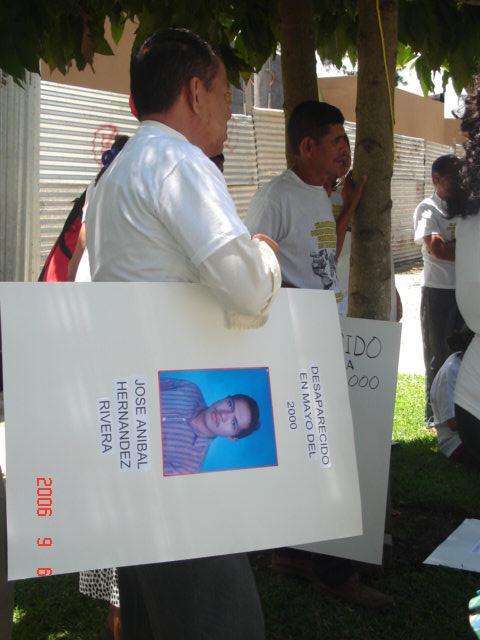

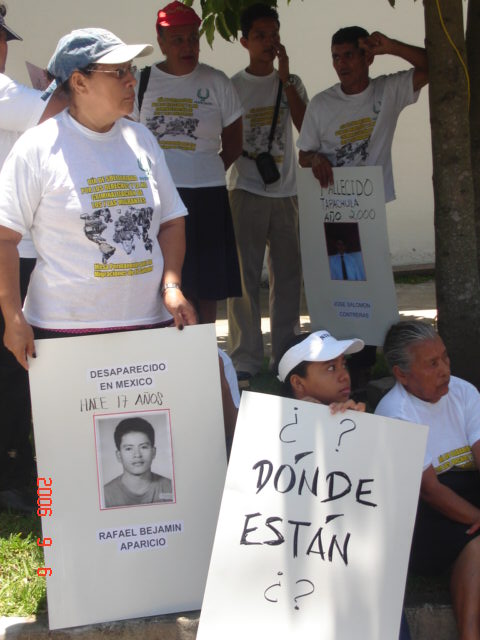
There are family members of those left behind. Their loved ones tried to go to the US through Mexico to find a job and now they have dissapeared or they have died during their time of transit. In the organization I work with, CARECEN International, we help look for those individuals who have died or dissapeared, but the process is not easy.
Today was the first march of COFAMIDE (Committee of Family Members of people who have died or dissappeared or died). Today, we marched to the Mexican Embassy to demand that they help us build a database that looks for migrants who have been found in Mexico. Tomorrow we are going to the Salvadoran government to demand that they finance and maintain this database.
As 700 Salvadorans leave their country every single day to find better opportunities in the US, our work is cut out for us. With the help of COFAMIDE, we will keep looking for people, but this time there are specific stories behind every request.
Today, some members of COFAMIDE could not come to the march because it´s too difficult. It´s too difficult to talk about the poverty that drove someone they love to look for opportunities in other countries. And its too difficult to imagine that thier loved ones have died. In Solidarity they were with us today as I hope you were as well.
Monday, August 28, 2006
Violence in El Salvador
I had a short visit to the States a few weeks ago, and when I was there I realized something about myself. I realized that I had been living my last year in El Salvador in a heightened state of awareness. And in some ways I sort of knew this, but it became all to real when I felt like I was finally able to breath and articulate my thoughts.
Imagine living in El Salvador, a place where a foreigner is not the only target. In other places around the world, someone who looks different is always an easy money maker for random robberies. But here in El Salvador, everyone is a target...and robberies turn into murders.
El Salvador has a culture of violence and trauma reinforced by a history of a brutal civil war; a war that ended with some peace accords that basically lied to the people by saying things were going to change. It is true, things did change. Many say that the poverty rate is worse now than when it was in the war. Imagine that, the people have gotten poorer? The rich polititians have brought in their neoliberal politics and trade agreements (CAFTA) to benefit their friends in corporations. And the people are slowly losing their right to march and protest the injustice going on in their country because as the government likes to say, the protests of the left are terrorist acts, so now there is new terrorist legislation.
Then there are the gangs. The gangs of El Salvador originated in the US, but with the slick deportation process of the US government, El Salvador found a new problem to deal with. The gangs are neither leftist or rightist, but Tony Saca likes to think the gangs are all leftist (even if Arena does pinta y pega with gang members during the elections). And so, with the easy solutions of the Arena government, all the youth of El Salvador are a target. So much for treasuring your future!
So when you couple a history of violence with a people in growing need for food, shelter and jobs, youth who are being targeted, gang members who target everyone (especially busses), and the slow political process that takes human rights away one by one, one might find a breading ground for a whole mess of effects brought on by this culture. One such effect is widespread violence.
A lot goes on in this country every day. Busses are attacked and burned if they didn’t pay the gang fare. Patrons of busses are robbed or killed every day. In the night there are shootings, and we have a homicide rate that is through the roof. Occasionally there are protests, but the last one turned into a police instigated riot with helicopters equipped with gunmen.
Now take all of this into consideration when you decide to leave your house. How would you prepare? What would you bring with you, and how would you act? These are the questions I’ve been asking myself everyday for the last year, and realized in the States that I didn’t need to worry about that!
I live in a pretty nice residential neighborhood with a gate and an armed guard. My area is pretty middle class, and they have luxuries like a car and pretty gardens. I have a pretty garden too, but I ride the bus. When I leave my house to start my day, I make sure that I have my wallet with not much more than $20. I have some money in my wallet, and some money outside of it (just in case if the bus I am on is robbed, I can just give them the few dollars I have that is not in my wallet...but because I am white, I might get hassled more because people think I am rich). In addition to my wallet I carry my visa card that is issued by the government. Because I have this special document, I don’t need to carry my passport like other foreigner friends of mine. If I am stopped by migration people, I pull out my card, have a little conversation with them and I am on my way. If any of my friends are stopped (and chances are they don’t have my same visa because it’s really hard to get) then they might be fined or even brought to migration, or even forced to leave in 48 hours.
I have my wallet and visa in one pocket and my $30 phone in the other pocket. I also carry a bag with an umbrella, water, my notebook and my agenda. I don’t carry much more than that because it could be stolen. When I am on the bus I try not to let myself drift too far off into daydream land. Sometimes that’s hard to do, but for the most part, I try to stay alert and be aware of who is getting on an off the bus and where I am in proximity. But the reality is, anyone and everyone is in danger at times. These same rules of being alert apply to walking in the street. I am usually very aware of where I am and who is near me when I am walking. I always pass men who have some cat call to project, but it’s safer to just keep on walking instead of saying or doing something that might feel OK in the States. I make sure that when I pass drunk men, that I am polite but that I keep walking, and I try to be aware of the places I can walk into in case there is a problem.
At night, the whole dynamic changes. Everything is more dangerous and people are more on edge. If I do go out at night, I try to go out with a group of people, I don’t ride public transportation after a certain point and if I am really far, I take a taxi home at night.
And then, because I am in El Salvador, the political situation has to be taken into account when leaving the false comfort of your home. There are always protests, marches, demonstrations, road blocks and the like going on at seemingly random moments. However, nothing is really random here, and it’s best if you can catch these hand ups quickly. As a foreigner, I can be arrested and deported if seen at a protest, so I steer clear of them for that reason. However, marches and demonstrations can easily turn into protests and those can easily turn violent, which is something I would rather not be a part of. The July 5th protest that I previously spoke about was not very far from where I conduct a lot of my life, and so it’s important for me to be aware of what’s going on before I leave the house (if at all possible).
You know, the reality is, living here is different...its difficult. But I am only here for a short while and basically I can leave whenever I want. What about the people who can’t leave...the people who can’t make enough money to move into a safer neighborhood where people aren’t being found dead in the morning? What about the women I know, who were waiting for a bus on pay day at the GAP maquilador that they work at, and they were robbed and rapped repeatedly? What about the young teenage boys who are afraid to leave their houses to go to a crafts workshop held by a church group, because the police will pick them up and even abuse them as targeted gang members (even if they really aren’t gang members at all)? What about the bus driver who didn’t pay the gang a special tax and so he gets shot and killed in broad daylight while his bus is set to flames? What about the man lies sprawled out on the sidewalk in a nice neighborhood with a gunshot in his head?
I am not trying to scare you with these thoughts and these stories, but think about it...a really large percentage of this world lives like this. Then take places like Iraq and Lebanon? What about the neighborhoods you never go in? The North end of Hartford...the projects...you know the places that you hear about on the news.
I mean, shouldn’t people have the right to be safe? Shouldn’t people have the right to FEEL safe?
I am leaving El Salvador in 6 months and I will be living in a place where I can breath again. I can go to work with a bunch of useless junk in my bag, my pockets full of money and money cards, I can listen to my MP3 player as I ride public transportation...and if I wanted to, I could escape and forget about it all.
Imagine living in El Salvador, a place where a foreigner is not the only target. In other places around the world, someone who looks different is always an easy money maker for random robberies. But here in El Salvador, everyone is a target...and robberies turn into murders.
El Salvador has a culture of violence and trauma reinforced by a history of a brutal civil war; a war that ended with some peace accords that basically lied to the people by saying things were going to change. It is true, things did change. Many say that the poverty rate is worse now than when it was in the war. Imagine that, the people have gotten poorer? The rich polititians have brought in their neoliberal politics and trade agreements (CAFTA) to benefit their friends in corporations. And the people are slowly losing their right to march and protest the injustice going on in their country because as the government likes to say, the protests of the left are terrorist acts, so now there is new terrorist legislation.
Then there are the gangs. The gangs of El Salvador originated in the US, but with the slick deportation process of the US government, El Salvador found a new problem to deal with. The gangs are neither leftist or rightist, but Tony Saca likes to think the gangs are all leftist (even if Arena does pinta y pega with gang members during the elections). And so, with the easy solutions of the Arena government, all the youth of El Salvador are a target. So much for treasuring your future!
So when you couple a history of violence with a people in growing need for food, shelter and jobs, youth who are being targeted, gang members who target everyone (especially busses), and the slow political process that takes human rights away one by one, one might find a breading ground for a whole mess of effects brought on by this culture. One such effect is widespread violence.
A lot goes on in this country every day. Busses are attacked and burned if they didn’t pay the gang fare. Patrons of busses are robbed or killed every day. In the night there are shootings, and we have a homicide rate that is through the roof. Occasionally there are protests, but the last one turned into a police instigated riot with helicopters equipped with gunmen.
Now take all of this into consideration when you decide to leave your house. How would you prepare? What would you bring with you, and how would you act? These are the questions I’ve been asking myself everyday for the last year, and realized in the States that I didn’t need to worry about that!
I live in a pretty nice residential neighborhood with a gate and an armed guard. My area is pretty middle class, and they have luxuries like a car and pretty gardens. I have a pretty garden too, but I ride the bus. When I leave my house to start my day, I make sure that I have my wallet with not much more than $20. I have some money in my wallet, and some money outside of it (just in case if the bus I am on is robbed, I can just give them the few dollars I have that is not in my wallet...but because I am white, I might get hassled more because people think I am rich). In addition to my wallet I carry my visa card that is issued by the government. Because I have this special document, I don’t need to carry my passport like other foreigner friends of mine. If I am stopped by migration people, I pull out my card, have a little conversation with them and I am on my way. If any of my friends are stopped (and chances are they don’t have my same visa because it’s really hard to get) then they might be fined or even brought to migration, or even forced to leave in 48 hours.
I have my wallet and visa in one pocket and my $30 phone in the other pocket. I also carry a bag with an umbrella, water, my notebook and my agenda. I don’t carry much more than that because it could be stolen. When I am on the bus I try not to let myself drift too far off into daydream land. Sometimes that’s hard to do, but for the most part, I try to stay alert and be aware of who is getting on an off the bus and where I am in proximity. But the reality is, anyone and everyone is in danger at times. These same rules of being alert apply to walking in the street. I am usually very aware of where I am and who is near me when I am walking. I always pass men who have some cat call to project, but it’s safer to just keep on walking instead of saying or doing something that might feel OK in the States. I make sure that when I pass drunk men, that I am polite but that I keep walking, and I try to be aware of the places I can walk into in case there is a problem.
At night, the whole dynamic changes. Everything is more dangerous and people are more on edge. If I do go out at night, I try to go out with a group of people, I don’t ride public transportation after a certain point and if I am really far, I take a taxi home at night.
And then, because I am in El Salvador, the political situation has to be taken into account when leaving the false comfort of your home. There are always protests, marches, demonstrations, road blocks and the like going on at seemingly random moments. However, nothing is really random here, and it’s best if you can catch these hand ups quickly. As a foreigner, I can be arrested and deported if seen at a protest, so I steer clear of them for that reason. However, marches and demonstrations can easily turn into protests and those can easily turn violent, which is something I would rather not be a part of. The July 5th protest that I previously spoke about was not very far from where I conduct a lot of my life, and so it’s important for me to be aware of what’s going on before I leave the house (if at all possible).
You know, the reality is, living here is different...its difficult. But I am only here for a short while and basically I can leave whenever I want. What about the people who can’t leave...the people who can’t make enough money to move into a safer neighborhood where people aren’t being found dead in the morning? What about the women I know, who were waiting for a bus on pay day at the GAP maquilador that they work at, and they were robbed and rapped repeatedly? What about the young teenage boys who are afraid to leave their houses to go to a crafts workshop held by a church group, because the police will pick them up and even abuse them as targeted gang members (even if they really aren’t gang members at all)? What about the bus driver who didn’t pay the gang a special tax and so he gets shot and killed in broad daylight while his bus is set to flames? What about the man lies sprawled out on the sidewalk in a nice neighborhood with a gunshot in his head?
I am not trying to scare you with these thoughts and these stories, but think about it...a really large percentage of this world lives like this. Then take places like Iraq and Lebanon? What about the neighborhoods you never go in? The North end of Hartford...the projects...you know the places that you hear about on the news.
I mean, shouldn’t people have the right to be safe? Shouldn’t people have the right to FEEL safe?
I am leaving El Salvador in 6 months and I will be living in a place where I can breath again. I can go to work with a bunch of useless junk in my bag, my pockets full of money and money cards, I can listen to my MP3 player as I ride public transportation...and if I wanted to, I could escape and forget about it all.
Tuesday, August 15, 2006
A story of Violence
Here is the blog of a friend of mine here in El Salvador. I am going to copy some text from her blog and also copy the link so that you can read it in more detail. If you can help, please do!
http://salijo05.blogspot.com/
Dear Friends, Family, and Supporters,I send you my greetings to you from El Salvador. I am still here working as a long-term volunteer, teaching English, coordinating youth sports programs, and organizing around environmental issues. I want to thank you all for your generous donations and your emails. I am inspired to report that the children here are putting the donated sporting equipment to good use on a daily basis and everything is going well Sadly, my motive for writing today is not of a joyful nature. I feel compelled to share this experience because this time, the danger we all face on a daily basis has come close to home.Around 3:00 am on Saturday, August 5th, Esper was leaving her job at a factory just outside the city of San Salvador. She and two co-workers were attacked by a group of armed men. It was payday so Esper and her co-workers had their monthly salaries of $150 cash with them. The men physically threw the three young women to the ground, beat them, and stole their money. They raped them repeatedly, taking turns. After, the men drove away.All three victims are currently in the hospital, recovering from their physical injuries and receiving medication to prevent the development of HIV and other sexually transmitted diseases. The anti-HIV medicine will cause them to be physically ill for the next few weeks and requires a proper diet which they could not afford on their current salary, let alone if the medication makes them too sick to return to work.My best friend Marina is Esper's sister. Marina is a full-time teacher during the week, and a night student at the University of El Salvador. She wants to take this semester off from her studies, so that she can work a second job to support Esper and her family through her recovery. If Marina stops studying this semester, she will delay getting her teaching certification, which in turn would get her fired from her teaching position, leaving her in a worse position than today.I can personally speak to how hard this entire family works to stay afloat financially, and to try to make a better life for themselves and their children. They are fighters and survivors, but this weekend’s violence has pushed them beyond their limits.It is not easy to hear stories like Esper's. There are a few things we can do to walk in solidarity with these women. First and foremost, we can send them our positive energy, and keep her and her coworkers in our thoughts and prayers.We can also ease their financial burden. Each woman lost a month’s salary, and may not be able to work while in recovery. My goal is to raise a minimum of $1,000, the equivalent of three months wages and medical costs for Esper’s family, and to give anything above that amount to the other two women who are also suffering. Please, consider committing to give $20 a month for the next three months to help out it would be the equivalent of giving up one movie night (no popcorn), or a week’s worth of Starbucks each month, and a wonderful way to contribute good karma to some very deserving people. I know that money is always tight, and I am as grateful for your positive energy, and for passing this email along to anyone you feel may want to participate, as I am for any donation you can make. I will continue to update you on Esper’s condition through my blog. You can donate by clicking on the link I put below. Please feel free to contact me with any questions you may have, or even just to pass along good wishes to Esper.Thank you, with loveSally Hansensalstar17@hotmail.comPlease feel free to pass this along to your friends, family, schools, and places of worship.
http://salijo05.blogspot.com/
Dear Friends, Family, and Supporters,I send you my greetings to you from El Salvador. I am still here working as a long-term volunteer, teaching English, coordinating youth sports programs, and organizing around environmental issues. I want to thank you all for your generous donations and your emails. I am inspired to report that the children here are putting the donated sporting equipment to good use on a daily basis and everything is going well Sadly, my motive for writing today is not of a joyful nature. I feel compelled to share this experience because this time, the danger we all face on a daily basis has come close to home.Around 3:00 am on Saturday, August 5th, Esper was leaving her job at a factory just outside the city of San Salvador. She and two co-workers were attacked by a group of armed men. It was payday so Esper and her co-workers had their monthly salaries of $150 cash with them. The men physically threw the three young women to the ground, beat them, and stole their money. They raped them repeatedly, taking turns. After, the men drove away.All three victims are currently in the hospital, recovering from their physical injuries and receiving medication to prevent the development of HIV and other sexually transmitted diseases. The anti-HIV medicine will cause them to be physically ill for the next few weeks and requires a proper diet which they could not afford on their current salary, let alone if the medication makes them too sick to return to work.My best friend Marina is Esper's sister. Marina is a full-time teacher during the week, and a night student at the University of El Salvador. She wants to take this semester off from her studies, so that she can work a second job to support Esper and her family through her recovery. If Marina stops studying this semester, she will delay getting her teaching certification, which in turn would get her fired from her teaching position, leaving her in a worse position than today.I can personally speak to how hard this entire family works to stay afloat financially, and to try to make a better life for themselves and their children. They are fighters and survivors, but this weekend’s violence has pushed them beyond their limits.It is not easy to hear stories like Esper's. There are a few things we can do to walk in solidarity with these women. First and foremost, we can send them our positive energy, and keep her and her coworkers in our thoughts and prayers.We can also ease their financial burden. Each woman lost a month’s salary, and may not be able to work while in recovery. My goal is to raise a minimum of $1,000, the equivalent of three months wages and medical costs for Esper’s family, and to give anything above that amount to the other two women who are also suffering. Please, consider committing to give $20 a month for the next three months to help out it would be the equivalent of giving up one movie night (no popcorn), or a week’s worth of Starbucks each month, and a wonderful way to contribute good karma to some very deserving people. I know that money is always tight, and I am as grateful for your positive energy, and for passing this email along to anyone you feel may want to participate, as I am for any donation you can make. I will continue to update you on Esper’s condition through my blog. You can donate by clicking on the link I put below. Please feel free to contact me with any questions you may have, or even just to pass along good wishes to Esper.Thank you, with loveSally Hansensalstar17@hotmail.comPlease feel free to pass this along to your friends, family, schools, and places of worship.
Monday, June 26, 2006
Salvadoran Gay Pride

The month of June is International Gay Pride Month. In large metropolitan cities like New York, Chicago, London or Paris, there tend to be large parades and events celebrating the diversity of sexuality, gender, gender identity and the millions of individuals who have struggled for equality and positive visibility. June is a month of awareness and acceptance for gay communities all around the world, in hopes that one day, people won’t be violated, discriminated against or shunned by their families. It’s a month of education and empowerment, of entertainment and conversation and maybe an extra push for some, to finally come out of the closet.
Here in El Salvador events for the month of June within the gay community are on a smaller scale, yet still alive and growing in vibrance and visibility. And this year, the big day was the 24th of June. The morning began with various groups setting up tents in the central park of El Centro, across from the cathedral. There, these groups displayed their work and held education forums on issues ranging from STDs, HIV / AIDS, condom application and other safe sexual practices.
(Side commentary: I was disappointed to find that the majority of conversations and information were based on sexual practices and disease prevention. On one hand, this heavy emphasis certainly reinforces certain stereotypes of the gay community, but on the flip side, the highly attended educational campaign reached individuals ranging in sexualities and sexual practices. I would have liked to have seen more conversation on gender identity and sexuality as a whole, however, I was quite surprised and impressed with the amount of people who courageously participated in such a taboo event in this homophobic country of El Salvador.)
Some highlights to this part of the day included the passing out of free condoms (male and female). I also got to watch one man transform into a woman (and a very attractive woman at that). I watched as another man applied his makeup, as they picked out his outfit and later, as she marched in the parade (notice the pronoun switch from he to she).
In addition to learning some new things about AIDS in El Salvador, I also had a lot of personal conversations with people who were willing to share their stories of being gay in El Salvador. I met one man, who I will not name at this time, who is a soldier in the Salvadoran military. This young man talked with me about his time in the military and his boss who forced him to have sex. He spoke about how his boss hit him and threatened his life if he did not engage in relations with him. In addition, when he reported the incident, the military denied the incident took place, and now there is a lengthy court case which could result in this soldier being put into jail. At the moment, this young man is not only suspended from the military while his case is pending, but he can't apply to any other jobs to make money because he is tied up in this case. He has been kicked out of his family (a military family) and has been staying with his grandmother. He further explained that he just wants this all to be over with, understanding that his boss will never be brought to justice with the amount of corruption here, and that he just wants his life back.
I met a lot of people who had similar stories of being shunned by their families, of moving from their pueblos to the city and finding acceptance among a few people here. The stories are not unlike many other gay people I know in the US and unfortunately, this seems to be the reality.
However, I did meet a mother who accompanied her son to the march because she wanted to support him. I met another young boy who guided us from the bus stop to where the march would take place, and he had many interesting things to say, at the ripe ate of eight. We asked him if he was involved in the movement at which he happily replied "yes!" We then asked him if anyone in his family was gay.
He nonchalantly replied, "No, I just have an uncle who dresses like a queen."
We later saw this boy walking through the march as if he had no care in the world. He seemed to know a lot of people, including a lot of the other men who dress like "queens". And I couldn't help but hope that this young boy, and his attitude, would develop into the future of this country and the handling of homosexuality.
In all, I had a really good and interesting time at this march of solidarity. I certainly had a unique experience that other foreigners were not getting. I found myself being very grateful for the community I have in the United States, and yet I also realized that there is a lot of work that needs to be done in the US as well. And so, as June is coming to a close, I wish all my GLBT friends and those who support us, a Happy and Healthy Gay Pride Month.
Thursday, May 11, 2006
Mothers Day Salvadoran Style.
The 10th of May marks Mothers Day in Latin America, no matter what day it is. This year, in El Salvador, places were decorated and the florists were filling the street corners waiting for sons and daughters to buy that special combination of colorful flowers for their mother.
Even though I am accustomed to celebrating Mothers Day on a different date, I still did a little bit of reflecting as Salvadorans honored their mothers (and mother figures).
I am finding in my life, that who you call Mom, says a lot about you. Here in El Salvador culture with a mix of poverty really changes the family dynamic. There are many single moms here and many women who have children with multiple men. I won’t explain the how or why of this (this is not the time of discussion), but I will say, that the role this woman plays in the child’s life is even more important. In addition, there are times when one or both parent leave the family to go North to support the family. Sometimes the family still stays in touch with the person who migrated, but that is not always the case.
I read a story recently in which a mom emigrated to the US to make enough money for the family. As a mother, she was the primary breadwinner for her family, but she was not the primary caregiver. Instead, the older sister assumed the role, which leads me to wonder. Who do Salvadorans call Mom? And when exactly does a woman become a mother?
Here, there is a strong presence of influential woman with strong character. I have met women here who are a definite force to be reckoned with and are seen as the matriarch of a whole family or community at times. These are the women who keep careful watch over every child (no matter what age) and keep the men in line and on their toes. In such a machismo culture, I find this reality to be surprising and a bit refreshing.
As a feminist who is blessed with many different individuals who have assumed mothering roles in my life, I often wonder what kind of mother I will become someday. Although I admire these strong Salvadoran women, I am not sure I want that kind of responsibility. It is my hope however, that my future partner and I complement each other in such a way that the typical mothering characteristics are distributed among the two of us. I feel that if life works out that way, then our child (or children) will understand that traditional gender roles do not need to be fulfilled to raise a healthy child, or to have a healthy family.
So in closing, Happy Mothers Day, to all those women and men who care for children and raise them to be happy and healthy adults. My blessings, gratitude and awe go to you…
Even though I am accustomed to celebrating Mothers Day on a different date, I still did a little bit of reflecting as Salvadorans honored their mothers (and mother figures).
I am finding in my life, that who you call Mom, says a lot about you. Here in El Salvador culture with a mix of poverty really changes the family dynamic. There are many single moms here and many women who have children with multiple men. I won’t explain the how or why of this (this is not the time of discussion), but I will say, that the role this woman plays in the child’s life is even more important. In addition, there are times when one or both parent leave the family to go North to support the family. Sometimes the family still stays in touch with the person who migrated, but that is not always the case.
I read a story recently in which a mom emigrated to the US to make enough money for the family. As a mother, she was the primary breadwinner for her family, but she was not the primary caregiver. Instead, the older sister assumed the role, which leads me to wonder. Who do Salvadorans call Mom? And when exactly does a woman become a mother?
Here, there is a strong presence of influential woman with strong character. I have met women here who are a definite force to be reckoned with and are seen as the matriarch of a whole family or community at times. These are the women who keep careful watch over every child (no matter what age) and keep the men in line and on their toes. In such a machismo culture, I find this reality to be surprising and a bit refreshing.
As a feminist who is blessed with many different individuals who have assumed mothering roles in my life, I often wonder what kind of mother I will become someday. Although I admire these strong Salvadoran women, I am not sure I want that kind of responsibility. It is my hope however, that my future partner and I complement each other in such a way that the typical mothering characteristics are distributed among the two of us. I feel that if life works out that way, then our child (or children) will understand that traditional gender roles do not need to be fulfilled to raise a healthy child, or to have a healthy family.
So in closing, Happy Mothers Day, to all those women and men who care for children and raise them to be happy and healthy adults. My blessings, gratitude and awe go to you…
Typical Sunday!
Every Sunday I have this ritual. It’s a new thing for me. I am trying to work on routine…trying to ground myself…trying to connect my heart to my environment. And so, I roll out of bed and start thinking about church. I think about it and ask myself if I really want to go. There was once a time in my life when it was just a given that I would go, but now, I find myself seeking other options for spirituality. I have been singing a new song.
If I decide to go to church, I do the normal life thing of getting dressed and all that jazz. I also eat something (even though it is against church teaching) and then I begin the journey. I jump on the number 46 bus…it goes from one poor neighborhood to another…I am somewhere in the middle of the line but economically speaking I stand out! I love riding the bus, and somehow that seems a bit strange to me…but never the less, it’s a part of my life. It’s such a real experience, passing through the different neighborhoods, looking at the people getting on and off, wondering where they came from and where they are going. That in itself is a spiritual experience. Its the reality of liberation theology right in front of me without ever stepping into a church. I wonder what the Vatican thinks of such revelations?
I’ve learned about the layout of the city by riding the buses and the images I have gathered run through my head when I think about the things I love about El Salvador. Mostly, its about the people….I have fallen in love as Arrupe would say. As the bus passes the big parks, and the hospital Rosales, I can’t help to feel a tug at my heart. People say that Rosales is the hospital for the poor and that you go there to die. It’s not a pretty sight and the people waking in and out of that place don’t really look alive. I don’t know how you could when dignity is handed over as admission. Someday I will go there to see it for myself…but for now, I just look at the reality from my bus window.
From Rosales, the number 46 goes down the hill to El Centro. And within minutes the streets are full of people and little booths of vendors selling everything from fruits and veggies to bootleg DVDs to clothing and tools. You can find anything at El Centro and for cheap. I love El Centro…I love that it’s dirty and raw…and real. To me, this is San Salvador. And after a while I can see the top the Cathedral which is my stop. My cute to get up is the stop light right before the central park. And when I do, I feel like I am stepping into a new reality. A change from observation to living.
It’s the Cathedral where Romero’s funeral mass was, when over 40 people were killed as the government opened fire. The Cathedral is where I was when I saw my first protest, when some people overtook the tower to protest the conditions in the prisons. The Cathedral is the only sight seeing place I went to when I first came to El Salvador back in 2001 after the earthquakes, and so every time I go to the Cathedral, I remember that experience. For me, the Cathedral is a central point of reference…or reflection and of internal conflict.
There are two religious services at the Cathedral on Sunday. The formal mass is held upstairs in the ornate décor of what you imagine a church to be. The doors are open and its loud and I call it the hierarchy mass, because that is the mass for the people who follow the Catholicism of the Vatican. Downstairs in the cripta is where I go to the Misa de los Pobres (The Mass of the Poor). This is the place where Romero’s body now rests and people come to pray at the monument that memorializes him. The people gathered are normal Salvadorans, many of whom are very poor and travel a bit of distance to celebrate there. This is the people’s mass and the people have to fight to keep it. The funny thing is, there is nothing out of the ordinary at this mass. The readings are the same, the offerings are the same, the priest has the same teaching…but the hearts of the people are different. Every Sunday, the people at this mass convert the readings and Romero’s past reflections into real soul food. They take the message and apply it to their life…the life that struggles to create social change. And I guess the hierarchy is threatened by that…
My Sunday trips to the Cathedral certainly don’t resemble the times I go to church with my family…but then again, my life here doesn’t really resemble the life I have anywhere else.
If I decide to go to church, I do the normal life thing of getting dressed and all that jazz. I also eat something (even though it is against church teaching) and then I begin the journey. I jump on the number 46 bus…it goes from one poor neighborhood to another…I am somewhere in the middle of the line but economically speaking I stand out! I love riding the bus, and somehow that seems a bit strange to me…but never the less, it’s a part of my life. It’s such a real experience, passing through the different neighborhoods, looking at the people getting on and off, wondering where they came from and where they are going. That in itself is a spiritual experience. Its the reality of liberation theology right in front of me without ever stepping into a church. I wonder what the Vatican thinks of such revelations?
I’ve learned about the layout of the city by riding the buses and the images I have gathered run through my head when I think about the things I love about El Salvador. Mostly, its about the people….I have fallen in love as Arrupe would say. As the bus passes the big parks, and the hospital Rosales, I can’t help to feel a tug at my heart. People say that Rosales is the hospital for the poor and that you go there to die. It’s not a pretty sight and the people waking in and out of that place don’t really look alive. I don’t know how you could when dignity is handed over as admission. Someday I will go there to see it for myself…but for now, I just look at the reality from my bus window.
From Rosales, the number 46 goes down the hill to El Centro. And within minutes the streets are full of people and little booths of vendors selling everything from fruits and veggies to bootleg DVDs to clothing and tools. You can find anything at El Centro and for cheap. I love El Centro…I love that it’s dirty and raw…and real. To me, this is San Salvador. And after a while I can see the top the Cathedral which is my stop. My cute to get up is the stop light right before the central park. And when I do, I feel like I am stepping into a new reality. A change from observation to living.
It’s the Cathedral where Romero’s funeral mass was, when over 40 people were killed as the government opened fire. The Cathedral is where I was when I saw my first protest, when some people overtook the tower to protest the conditions in the prisons. The Cathedral is the only sight seeing place I went to when I first came to El Salvador back in 2001 after the earthquakes, and so every time I go to the Cathedral, I remember that experience. For me, the Cathedral is a central point of reference…or reflection and of internal conflict.
There are two religious services at the Cathedral on Sunday. The formal mass is held upstairs in the ornate décor of what you imagine a church to be. The doors are open and its loud and I call it the hierarchy mass, because that is the mass for the people who follow the Catholicism of the Vatican. Downstairs in the cripta is where I go to the Misa de los Pobres (The Mass of the Poor). This is the place where Romero’s body now rests and people come to pray at the monument that memorializes him. The people gathered are normal Salvadorans, many of whom are very poor and travel a bit of distance to celebrate there. This is the people’s mass and the people have to fight to keep it. The funny thing is, there is nothing out of the ordinary at this mass. The readings are the same, the offerings are the same, the priest has the same teaching…but the hearts of the people are different. Every Sunday, the people at this mass convert the readings and Romero’s past reflections into real soul food. They take the message and apply it to their life…the life that struggles to create social change. And I guess the hierarchy is threatened by that…
My Sunday trips to the Cathedral certainly don’t resemble the times I go to church with my family…but then again, my life here doesn’t really resemble the life I have anywhere else.
Subscribe to:
Posts (Atom)